
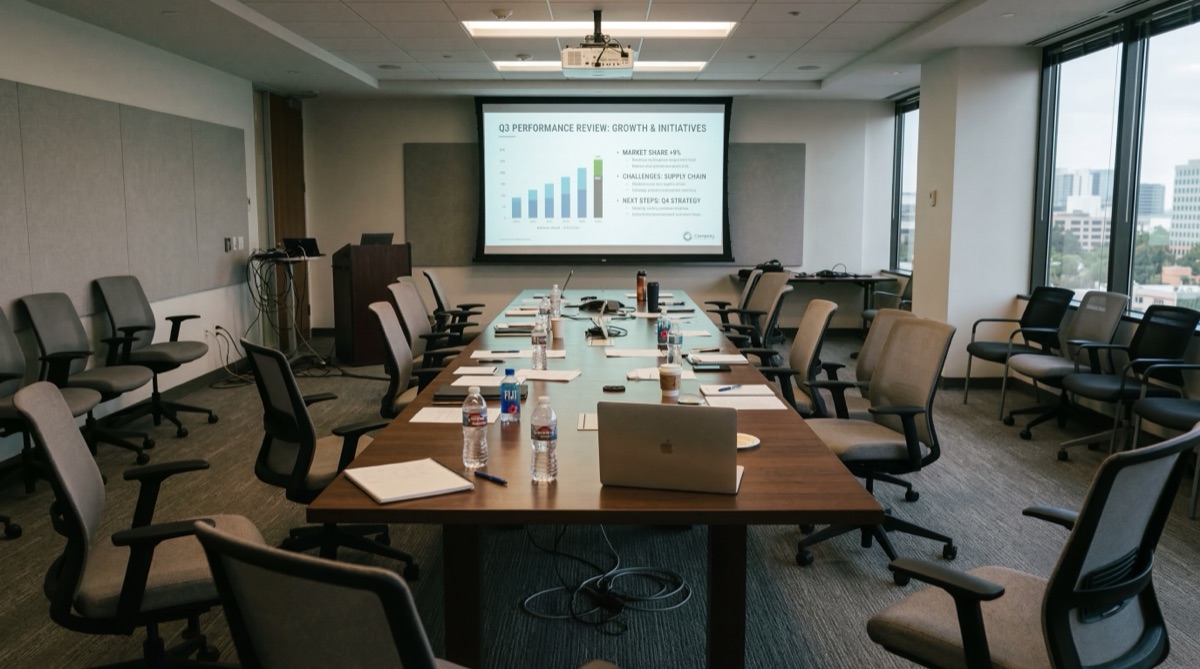
Think about the last presentation you sat through. Not the one you gave. The one you watched.
You probably remember the opening. Maybe it was a title slide with too many logos. Maybe someone said "Can everyone hear me?" into a microphone that was clearly working. Maybe there was a stock photo of people high-fiving in a boardroom, and you quietly died inside.
Now think about slide two. Can you remember it? Can you remember anything between the opening and whenever your phone came out of your pocket?
Probably not. Because that's where most people check out. Not because they're rude. Because the presentation didn't give them a reason to stay.
Eight Seconds Is Not a Statistic
People throw around the "eight-second attention span" line like it's a diagnosis. Like we've all collectively become goldfish. That's not what's happening.
Our attention spans are fine. We binge twelve episodes of a show in a sitting. We read entire novels on the train. We spend three hours assembling flat-pack furniture because the instructions are somehow both too detailed and not detailed enough.
We don't have an attention problem. We have a relevance filter. And that filter is fast. Within seconds, your audience is making a decision: is this worth my time, or should I check my email?
That's not eight seconds of attention. That's eight seconds of audition. You're auditioning for their continued focus. And if you don't pass the audition, you don't get the part.
We don't have an attention problem. We have a relevance filter. And that filter is fast.
This Applies to Everything
It's not just presentations. It's everything you build.
Your website homepage has the same audition. Someone lands on it, and within seconds they've decided if they're staying or scrolling past. The headline either earns their attention or it doesn't. There is no second chance at a first scroll.
Your eLearning module has the same audition. A learner opens it, sees the first screen, and decides whether this is going to be useful or whether it's another compliance box to tick on autopilot. If the first screen looks like every other mandatory training they've ever clicked through, they've already mentally checked out. They'll finish it. But they won't learn anything.

Your pitch deck has the same audition. A potential client opens your proposal, and the first page either says "this person understands my problem" or "this is a template." By page two, they've either leaned in or started scanning for the price.
Designing for the Moment of Decision
So how do you design for those eight seconds? Not with tricks. Not with animations or sound effects or shock tactics. Those get initial attention, but they don't hold it.
You hold attention by answering the only question your audience actually cares about: "Is this for me?"
That means your first slide needs to be about their problem, not your credentials. Your homepage needs to speak to their situation, not your services list. Your eLearning module needs to open with a scenario they recognise, not a learning objectives screen that reads like a legal document.
The first moment is about recognition. "This person gets it. This is about me." Once you've established that, you've earned the second slide. And the third. And the rest.
The Uncomfortable Maths
If 60% of your audience checks out by slide two, then everything you put on slides three through forty is wasted. All that research. All that design. All that content. Invisible to more than half the room.
The fix isn't making better slides three through forty. The fix is making slide one so relevant, so specific, so clearly about the audience that they put their phone down and lean forward.
The fix isn't making better slides three through forty. The fix is making slide one so good they put their phone down.
Nobody reads the second slide. Unless the first one earned it.

Nic Gallardo
Healthcare Instructional Designer - Perth, WA